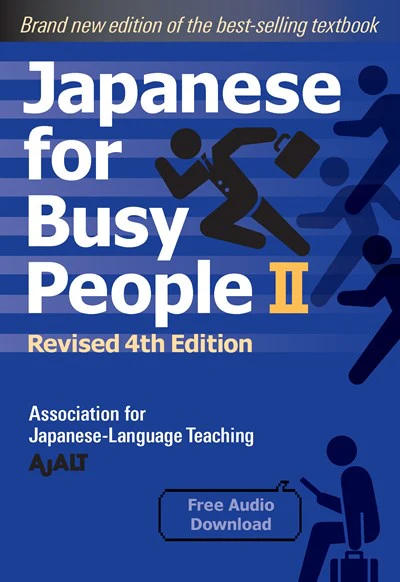
Japanese for Busy People Book 2
328 pages | paperback |
Â
4th Revised Edition of JAPANESE FOR BUSY PEOPLE, the most popular Japanese language textbook series in the world. Now comes with free downloadable audio recordings.
Â
Since it was first published in 1984, the focus of the Japanese for Busy People series has always been to teach Japanese for effective communication.
Â
Picking up where Japanese for Busy People Book I left off, Japanese for Busy People Book II goes beyond survival Japanese, turning to the basics of Japanese syntax, enabling learners to make a smooth transition from mid-beginner-level to intermediate-level Japanese.
Â
Grammar and content topics are carefully selected to assist learners to effectively develop sentence patterns and vocabulary related to each topic through the practice of talking about them. Kanji (Chinese characters used in Japanese) are gradually introduced in Book II along with furigana so that learners know how to pronounce them.
Â
By the end of the book, learners will have acquired through a series of concise grammatical explanations and extensive speaking and listening exercises a command of Japanese that will enable them to carry on a variety of daily conversations.
Â
Audio recordings can be downloaded for free from kodansha.us.
Product Information
Product Information
Shipping & Returns
Shipping & Returns
Description
328 pages | paperback |
Â
4th Revised Edition of JAPANESE FOR BUSY PEOPLE, the most popular Japanese language textbook series in the world. Now comes with free downloadable audio recordings.
Â
Since it was first published in 1984, the focus of the Japanese for Busy People series has always been to teach Japanese for effective communication.
Â
Picking up where Japanese for Busy People Book I left off, Japanese for Busy People Book II goes beyond survival Japanese, turning to the basics of Japanese syntax, enabling learners to make a smooth transition from mid-beginner-level to intermediate-level Japanese.
Â
Grammar and content topics are carefully selected to assist learners to effectively develop sentence patterns and vocabulary related to each topic through the practice of talking about them. Kanji (Chinese characters used in Japanese) are gradually introduced in Book II along with furigana so that learners know how to pronounce them.
Â
By the end of the book, learners will have acquired through a series of concise grammatical explanations and extensive speaking and listening exercises a command of Japanese that will enable them to carry on a variety of daily conversations.
Â
Audio recordings can be downloaded for free from kodansha.us.